
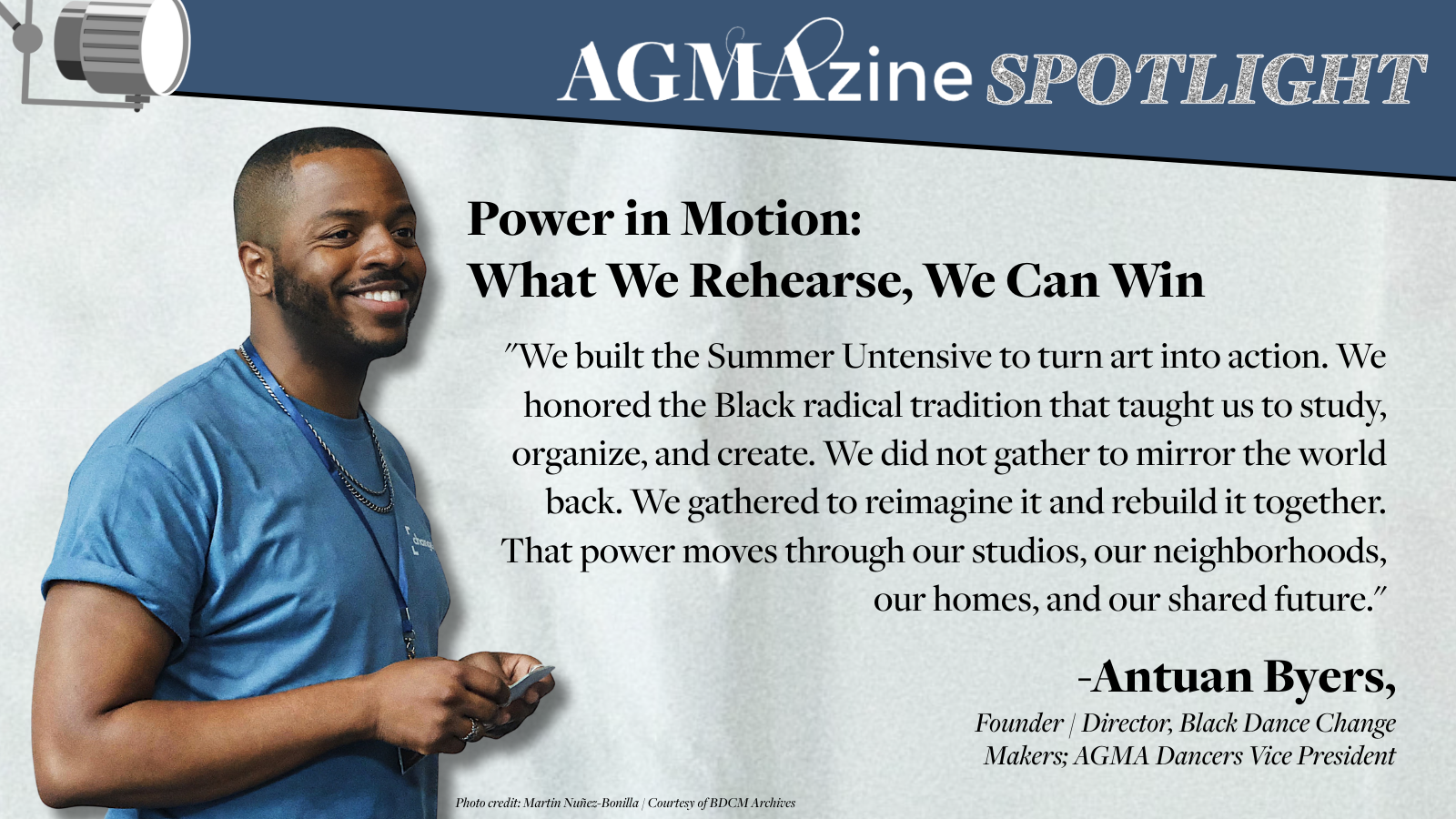
In today’s AGMAzine spotlight, AGMA Dancers Vice President Antuan Byers leads readers through the reasoning behind and the impact of the first Summer Untensive hosted by the Black Dance Change Makers. Each session was carefully curated for dancers and culture workers, providing a collaborative learning environment that fosters equal growth and development, manifesting material change for Black Dancers. From the altar’s grounding practice to campaign-building sessions like Power in Motion, choreography and strategy moved side by side, transforming the studio into a laboratory for disciplined experimentation, trust, and shared responsibility. Join him as he lays out the journey from ideation to actualization.
Antuan’s essay is featured on page 6 of the Winter 2025 issue of AGMAzine.
Power in Motion: What We Rehearse, We Can Win
By Antuan Byers, Founder/Director, Black Dance Change Makers; AGMA Dancers Vice President
The Summer Untensive was a first for Black Dance Change Makers (BDCM) this past summer, a focused weekend for dancers and culture workers to train together in political education, community care, and organizing skills. It turned impulse into infrastructure and tied our practice to material change. Come along for a run-through, holding the rhythm as we lay out the steps and the stakes.
Impulse
We built the Summer Untensive to turn art into action. We honored the Black radical tradition that taught us to study, organize, and create. We did not gather to mirror the world back. We gathered to reimagine it and rebuild it together. Choreography sat next to strategy, so what began in the studio could live beyond the weekend. That power moves through our studios, our neighborhoods, our homes, and our shared future.
Intent
The Summer Untensive was more than a weekend of workshops. It was a transformative space, a spark, a blueprint, a homecoming. People felt sharpened, seen, and set free. Though it was our first Untensive, it stands inside a long lineage of movement workers, cultural strategists, and freedom dreamers. From the Highlander Center and Combahee River Collective to the Student Nonviolent Coordinating Committee and the Black Youth Project 100, from Urban Bush Women to SLMDances. Rooted in curiosity, care, joy, and resistance, the Untensive called us back to our power and into action.
The Warm-Up
In Black traditions across the diaspora, the altar serves as a space of ancestor regard and decision-making, where offerings and names keep our commitments visible. We began at the altar because power needs a center. Beginning here gave the weekend a spine, rooted in our shared histories and futures. The altar is not décor. It is our first contract, the place where we name who we answer to and commit to how we will treat each other. We cleared a table, laid a cloth, and set fresh flowers. One by one, people stepped forward, placed one thing from their life, spoke one name aloud or held it in silence, and took a breath with the room. The altar transformed strangers into partners and prepared the room for the real work.
Power In Motion
Power in Motion was one of the sessions at the Summer Untensive, a focused training and campaign-building practicum facilitated by the BDCM team, including Etana Sissoko, Alysia Johnson, and Morgan McDaniel. It sat alongside workshops that brought us into our bodies, made our shared lineage visible, practiced moving together through residue and repair, and invited us to imagine our role as artists in the world ahead. Guest contributors included Dr. Charmaine Warren, Sydnie L. Mosley, Eva Yaa Asantewaa, and Catherine Kirk, who guided this work with care and precision.
In our session, we moved through organizing fundamentals like Mobilizing versus Organizing, and Strategy versus Tactics, into the drill of problem, issue, demand, and then tested winnability. We anchored the work in the Dallas Black Dance Theatre fight, one I was deeply involved in. After the entire main company was terminated, AGMA staff and the dancers built a sequenced strategy that combined public letters, filings with the National Labor Relations Board, pickets, media campaigns, and a self-produced concert that helped carry their message of resilience. The conflict drew a federal complaint and later a landmark settlement. We treated that arc as a map that dancers, artists, and organizers can adapt for their own campaigns.
What We Learned / Director’s Notes
Improvisation
Improvisation is our framework for revealing what was and what can be. If we want a world we have never seen, we must try moves we have never made. The studio is a lab where experimentation is disciplined, not random. We run short drills on problem, issue, and demand, then push past the familiar tactic to test an unfamiliar one. Spontaneity has a purpose. Exploration is bound by care. Trust is an active practice, built through spotting each other, naming clear roles, and radical consent that gives us permission to adjust the tempo when needed. Putting ideas in our bodies first teaches us to pivot without losing the phrase, to hold direction when conditions shift, and to craft a strategy that breathes.
Rehearsal
Rehearsal makes the work durable. We map power repeatedly, name decision-makers, and run one-on-ones until they read as partnering. Notes become edits that tighten the demand, refine the timeline, and clarify who moves whom.
This sits in a clear lineage. At Highlander, civil rights organizers rehearsed nonviolent sit-ins before stepping into hostile rooms, building skill, courage, and clarity through practice; in Nashville, Rev. James Lawson’s workshops drilled role-plays so students could meet violence with disciplined nonviolence. We draw on contemporary scholarship—like Barker, Dale, and Davidson’s Revolutionary Rehearsals in the Neoliberal Age and on Chenoweth and Stephan’s empirical civil-resistance work, including Why Civil Resistance Works—which together show how disciplined, iterative practice turns uprisings into durable wins. Jessica Gordon Nembhard’s Collective Courage complements this frame by documenting how Black cooperative organizing builds the democratic muscle and infrastructure that movements rely on in the moment and long after the moment has passed.
The lesson is consistent. Movements that train, iterate, and stage wins build capacity for larger fights. Just as there are hundreds of Intensives each year, sharpening our technical and artistic skills, we need just as many sites like the Untensive, committed to unlearning by way of care practice, political study, and collective transformation. That is essential to how we get free.
Performance
Performance is the public test of all that practice.
Choreography becomes strategy when the house lights come up.
The Dallas Black Dance Theatre fight showed what disciplined performance looks like offstage. Across our union, we have watched world-class artists perform outside the theater to improve their lives with the same rigor they bring to the stage. From AGMA Artists’ role in the Metropolitan Opera recently receiving $5 million in New York State funding, to newly ratified contracts at Alvin Ailey American Dance Theater and San Francisco Opera, the visible win rests on months of improvisation and rehearsal that clarify the problem, cut an issue to size, craft a demand, and choose tactics that escalate with purpose to deliver material change.
Finale
This is not a recap. It is a handoff.
We are artists. We know how to hold the rhythm, jump, and land together.
Improvisation opens the door. Rehearsal makes it durable. Performance delivers the win.
That is how change learns to stay.
Encore