
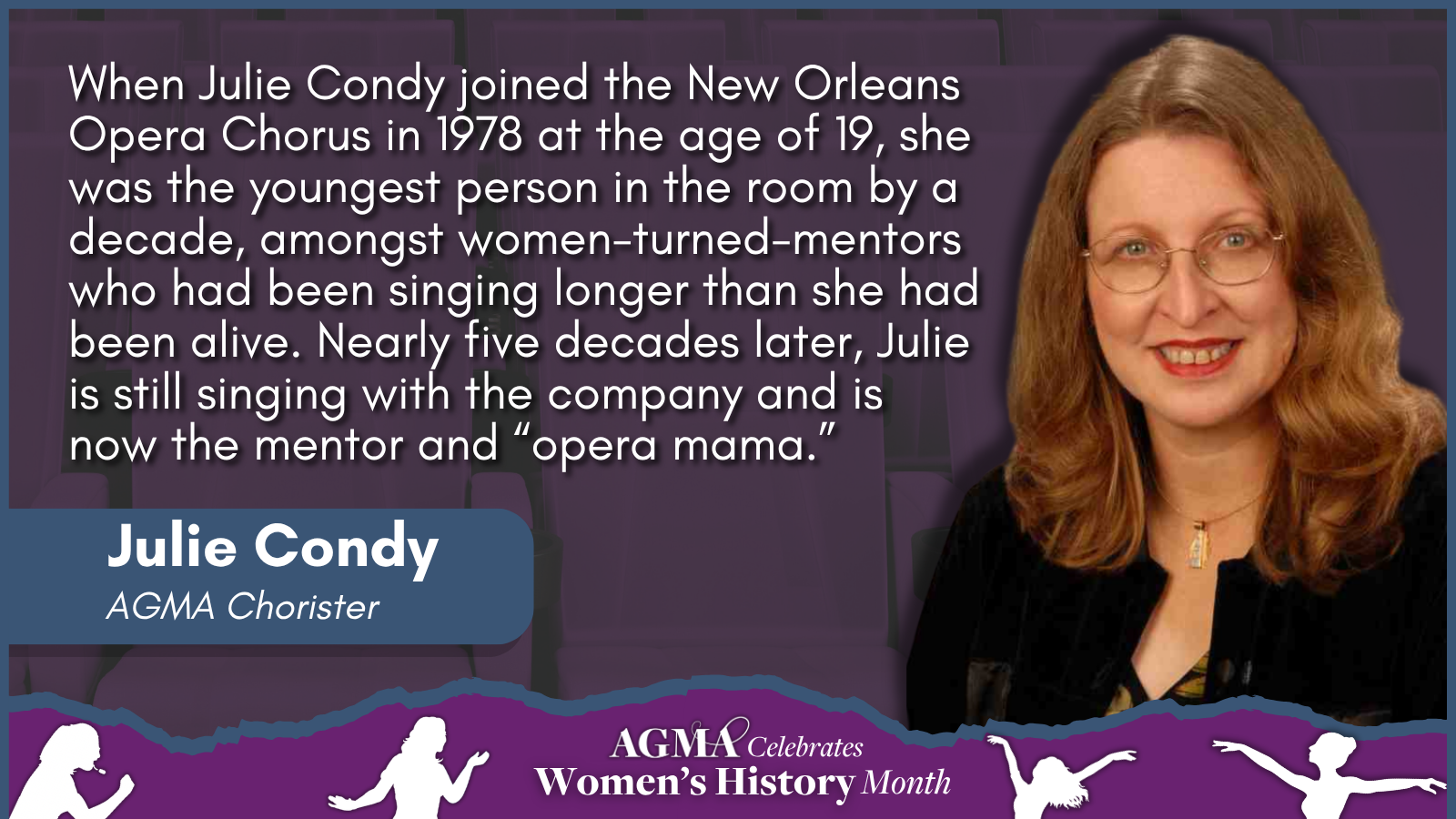
AGMA is proud to spotlight Julie Condy, a longtime member of the New Orleans Opera chorus whose nearly five-decade career reflects the enduring power of mentorship, artistry, and solidarity among women in the performing arts. In this conversation with AGMA’s Communications Coordinator, Julie reflects on the “opera mamas” who guided her as a young singer and the legacy she now carries forward as a mentor, educator, and union leader.
When Julie Condy joined the New Orleans Opera (NOO) chorus in 1978 at the age of 19, she was the youngest person in the room by a decade, amongst women-turned-mentors who had been singing longer than she had been alive.
“They took me under their wings, and the care and concern they had for me as a young singer was remarkable,” Julie shares. “I learned about their lives and how to live a good life through them: their stories, their marriages, their careers. They taught me stage technique; how to perform, how to be a good opera chorister. They would regale me with stories and the long connections and history that made being in the NOO chorus so special. They are my family, the members of the chorus had been together for years, and we all considered each other as family.”
Julie happily recalls her “opera mamas.” Chorus members like Barbara Bernard, Karen Kalin, Mary Bertucci and Karen’s mother Beryl, who was 70% deaf and still singing with perfect pitch—passing along the anecdotes that helped shape her to her younger colleagues.
Nearly five decades later, Julie is still singing with the company and is now the mentor and “opera mama.” When she founded a children’s theater in the 1990s, she ran it with the same intentional care those women had shown her, structured with professional discipline and a deep belief that young artists deserved to be taken seriously. In the late 1990s, her theater kids became the NOO’s children’s chorus, and the chorus ladies embraced them as their own — “opera grandchildren” to those she called her “opera mamas.” Their reign of influence stretches even further as one of Julie’s former students, Lindsay Reynolds, is now preparing for her Metropolitan Opera debut.
“When I was running my children’s theater for 25 years, I ran it like an AGMA shop. We had a schedule, and we lived and died by the schedule: no changes within seven days, everything according to the contract, with a stage manager in charge,” she says. “Lindsey Reynolds is an example of the forward motion of that professionalism and the values that stretch back to the women who sang with the opera in the 40s and 50s.”
In fact, it was that same generation of women who eventually pushed Julie into her role as AGMA representative, a position she has held since 2001. Julie’s leadership within AGMA has only grown, especially on the Board of Governors. She has shepherded the NOO chorus through Hurricane Katrina, the COVID-19 pandemic, and the ongoing challenges of organizing part-time choristers in a right-to-work state. Her compensation? Seeing younger generations of performers understand the necessity of a union, not only through hard times but also in fine times.
“At little shops like mine, we love what we do, and a lot of us are really committed and have been committed for decades,” she says. “But getting new people to join the Union poses a major stumbling block, especially in right-to-work states. Many don’t understand the benefits of being a union member. But just recently, I saw a glimpse of hope that helps me keep going. One of the soloists I convinced to join AGMA a few years ago gave me a big bear hug and said, ‘Thank you for convincing me to join. I didn’t understand how important it was until this year.’”
For Julie, the throughline from that first night in 1978 to the present is clear. She has always aimed to be a constant in the lives of others, just as her opera mamas were for her. For 47 seasons, she has done just that and has no intention of stopping.
This article is dedicated to Julie Condy’s opera mamas:
In honor of Kathy Rehage and Shirley Stewart. In memory of Mary Bertucci, Karen Kalin, Shirley Bertram, Lydia Burks, Barbara Bernard, Kay Long, Thelma Shilen, and Beryl Kalin