
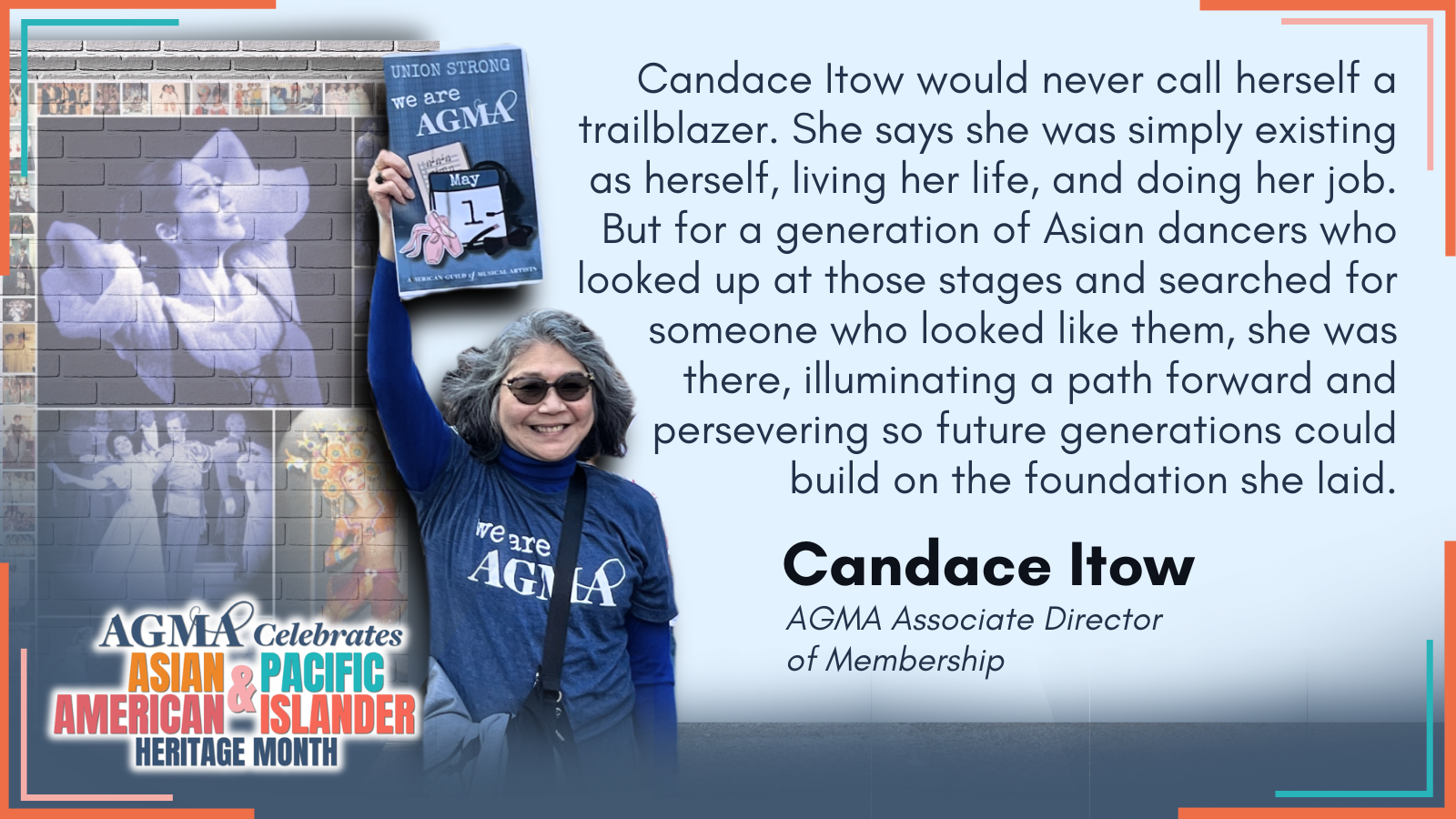
In this AAPI Heritage Month Spotlight, AGMA’s Communications Coordinator interviewed Candy Itow about her decades-long career as a dancer, union advocate, and AGMA staff member. Itow reflected on growing up Japanese-American in postwar Philadelphia, navigating racism and invisibility in the performing arts, and becoming a powerful voice for dancers and workers through her leadership within AGMA.
Candace (Candy) Itow’s mother signed her up for dance class at age nine, never expecting that it would spur a decades-long career in ballet.
Growing up Japanese-American in postwar Philadelphia, Candy learned early what it meant to be othered. Her parents had been interned at the Gila River War Relocation Center in Arizona during World War II, and even after they were released, the effects of wartime stayed with the family.
“Being Asian in Philadelphia was just… noticeable,” she explains. “We’d get in a taxi, and someone would ask my mother if she was a war bride. She would always answer: ‘No, I’m a Japanese-American.’ Kids would play war games and shout things. People would get in my face and imitate ‘Chinese talk’.”
“I was always being asked where I was from,” she continues. “During the Vietnam War, when people would ask me that, I started saying, ‘I’m a fifth column infiltrator.’ That shut things down pretty quickly.”
That steady insistence on dignity her mother portrayed, on being seen for who she truly was, became a lesson Candy carried with her everywhere.
She began performing in Philadelphia, then danced with the Pittsburgh Opera and the Pittsburgh Ballet Theatre before joining the New York City Opera (NYCO) in 1971, where she would remain for more than 30 years.
At that time, there were very few Asian performers in the performing arts. The rarity of seeing herself reflected on stage became something Candy learned to process through humor, though her peers did not always understand the deeper meaning. One of those moments came during a rehearsal at NYCO, when Candy caught herself reacting with surprise to seeing an Asian performer on television, only to realize she was looking at herself. When she later shared the story with fellow dancers, most of them did not understand why it was funny or significant.
“The only person who laughed was Raven, because she was Black and she understood the joy of seeing someone who looked like you on stage. Everyone else was just confused; they couldn’t relate.”
Raven Wilkinson, a pioneering Black ballerina who had broken barriers herself, joined NYCO the same season that Candy took a leave of absence. She stepped into Candy’s place, and soon the two became close friends, sharing a room on tour and staying close friends for decades. She passed away in 2018.
“She would keep me on the phone for hours. I’d be doing other things while she talked. She had so much knowledge of New York and its history, and it was really wonderful to hear. I was, unfortunately, the person who did the welfare check when she passed away. I miss her all the time. There are so many moments when I still want to pick up the phone and call Raven,” she said.
While managing her professional life in dance, Candy was also building something lasting within advocacy. Starting in the mid-1970s, she served as an AGMA dancer delegate at NYCO for over 20 years, in the early years often as the only dancer at the negotiating table. She joined the AGMA Board of Governors in 1978, was elected Recording Secretary three times, and served on the Union’s Executive Council in its early days up until joining AGMA’s professional staff.
When a company’s management team tried to add harmful, artistic non-re-engagement language to the Regular Dancers’ agreement of “true attrition,” Candy went straight to the board to seek strike authorization, brought together representatives from every section of the shop, and won with their support. When AGMA staff said not to put 240 members out of work over just eight dancers, she proved them wrong and even convinced representatives from every section of the shop to attend the meeting in solidarity: staging staff, extra chorus, and regular choristers all gathered in support of the dancers. This display of support ultimately swayed management’s resolve and led to the language not being enforced for the remainder of the contract and being removed from the contract in the subsequent negotiations.
In 2003, the same year she retired from performing, Candy joined AGMA’s professional staff as Membership Supervisor. She brought decades of experience, the trust of her colleagues, and a real understanding of what it means to be a member who needs support. She continues to show up for others in the same way.
Candy Itow would never call herself a trailblazer. She says she was simply existing as herself, living her life, and doing her job. But for a generation of Asian dancers who looked up at those stages and searched for someone who looked like them, she was there. She may have stood out in her neighborhood, at school, on stage, and at the negotiation table, but she illuminated a path forward, persevering so future generations could build upon the foundation she laid.