
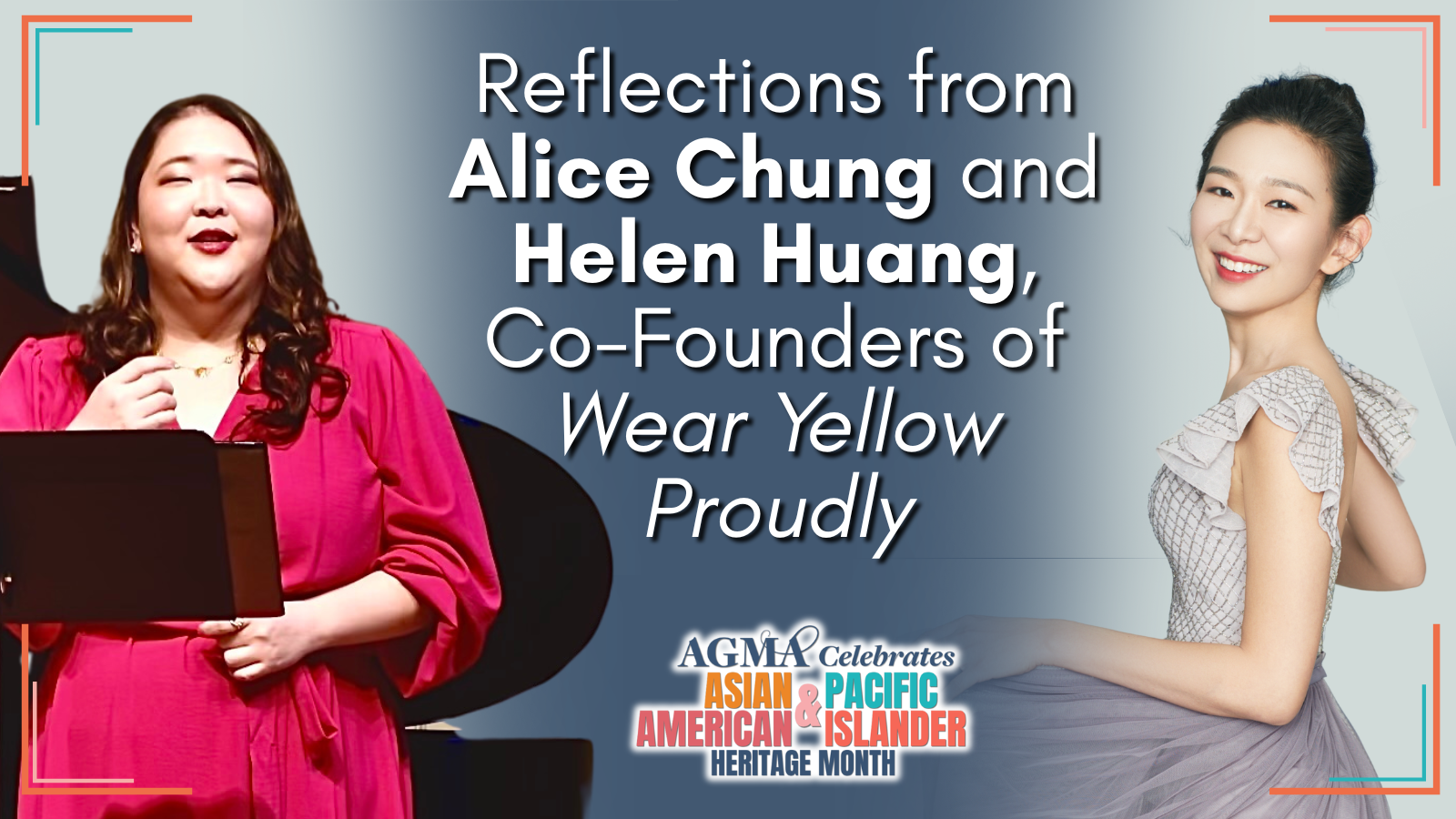
In AGMA’s final AAPI Heritage Month Spotlight, we highlight personal submissions from Wear Yellow Proudly co-founders Alice Chung and Helen Huang.
AAPI Heritage Month Spotlight: Wear Yellow Proudly Co-Founder Alice Chung Reflects on Being Asian American in Opera
By AGMA Soloist Alice Chung

As a Korean American singer who hasn’t touched a step in Asia, my identity has become more and more of a topic I wrestle with every time I don a character that is Asian. The Korean I’ve learned is the one my parents taught me, and most of the “software” hasn’t been updated to reflect the current language and culture. As someone who has been told that I’m not Korean by other Koreans, it’s certainly a reminder of how I will never be assumed to be American on the surface despite my birthright and values, but I wouldn’t be accepted as Korean either.
But, what I wonder most is: when will Asian American stories be on the operatic stage…and STAY there? Every time I sing Suzuki, I wonder if I am too Western in my portrayal. And yet, I refuse to let myself share a traditionally reserved portrayal of Suzuki because I refuse to believe that Suzuki is only one type of woman. While operas have been written (and are still being written), producing larger new works is ultimately a time-consuming and risky process.
In an art form that has exoticism and orientalism ingrained in it, we have no choice but to use Madama Butterfly, Turandot, etc., as opportunities to gain a foothold and plan to correct and uplift as much as possible within our control. But we cannot change the industry through these operas. It simply isn’t enough, at least, not for me. This is where Wear Yellow Proudly comes in.
During the pandemic, Wear Yellow Proudly (WYP) was founded. Created by my co-founder, Helen Zhibing Huang, and me, WYP’s mission is to foster understanding of our diverse Asian cultures, uplift Asian American voices, and redefine what it means to be Asian American. WYP has become the platform for creating unique, intimate musical experiences that can’t be accomplished on an operatic stage. There are many songs written by Asian Americans that reflect the emotional and cultural intersectionality experiences of Asian Americans, yet our academic curriculum hardly features them, even though countless Asians study vocal performance in the United States. When our representation isn’t reflected in our academic foundation, how do we continue to make progress in the industry? For WYP, it’s producing concerts that bridge these gaps of representation and understanding.
Grappling with these issues has defined who I am as an artist and what I want from the opera industry in my lifetime. I want opera to reflect our emotional depth and profound expression, which are often lost in cultural exchange. I want our industry to be more inclusive of our vibrant communities. I want our community to be empowered to create opportunities and be more vocal with companies. Finally, I want the stories and operas shared to feel like we can embody them as humans, rather than feel weighed down by having to undo incorrect traditional practices. Asian and Asian American opera SHOULD feel as easy (with appropriate research) as embodying a role in traditionally Western opera, if not more.
And, until then, really, beyond that, our work at Wear Yellow Proudly is how I contribute to maintaining our narratives, vision, and representation.
AAPI Heritage Month Spotlight: Wear Yellow Proudly Co-Founder Helen Huang on Creating a Space for Herself
By AGMA Soloist Helen Huang

I moved from Beijing to the United States when I was 12, which meant I was split across two countries, and for a long time, I felt like I belonged fully to neither.
In China, I was just a person growing up, figuring things out. In the U.S., I became ‘Asian.’ I quickly learned that being Asian–especially being an Asian woman–came with a set of expectations, a checkbox someone had already built for you before you walked in the room. But the box was never the same box twice. The Chinese moms in Virginia expected me to be a certain kind of Chinese, while my white American teachers expected something else entirely. Everyone had a different version of me they needed me to be, and none of those versions were quite mine. I never fit any single box. I was too American for some, not American enough for others. Too Chinese in one room, not Chinese enough in another.
Unfortunately, the classical music world–the world I had chosen, the world that had chosen me–-had its own expectation boxes too. There is a particular kind of scrutiny that follows an Asian woman onto the operatic stage. People have assumptions about what you are there to do, what you are capable of, and what stories you are allowed to tell.
For years, I carried that feeling of being stuck in the middle, knowing that other people were constantly trying to locate me, to place me, when all I wanted was to simply be myself.
What changed things for me was finding my own way to tell stories on my own terms. During the pandemic, my co-founder, Alice Chung, and I founded Wear Yellow Proudly (WYP) to share the many and diverse Asian cultures, narratives, and experiences through music. We began building recital programs that didn’t ask me to choose, programs that held the full complexity of who I am. For the first time, I was telling my own stories, creating on my own terms, and hopefully, opening that same door for other Asian artists.
I know the feeling of being stuck in between will never fully go away. I know there will always be someone trying to place me, to fit me into a box. But now through WYP, I know I can be who I am and express my truth through my music, without waiting for anyone’s permission. And I hope it will also give many other Asian artists in America the opportunity to be fully, stubbornly themselves.