
AGMA Dancer Nya Bowman has always perceived the performing arts as more than just movement or words; she sees them as sites of truth—truth about the body, voice, and power. Throughout her career as a dancer, actor, teacher, and advocate, she has navigated predominantly white artistic spaces where Black artists are often told, implicitly or explicitly, that there is only room for one opportunity, one role, and only ONE “exception.” She explains that this scarcity mindset is taught, reinforced, and weaponized to keep Black artists competing against each other instead of standing united.
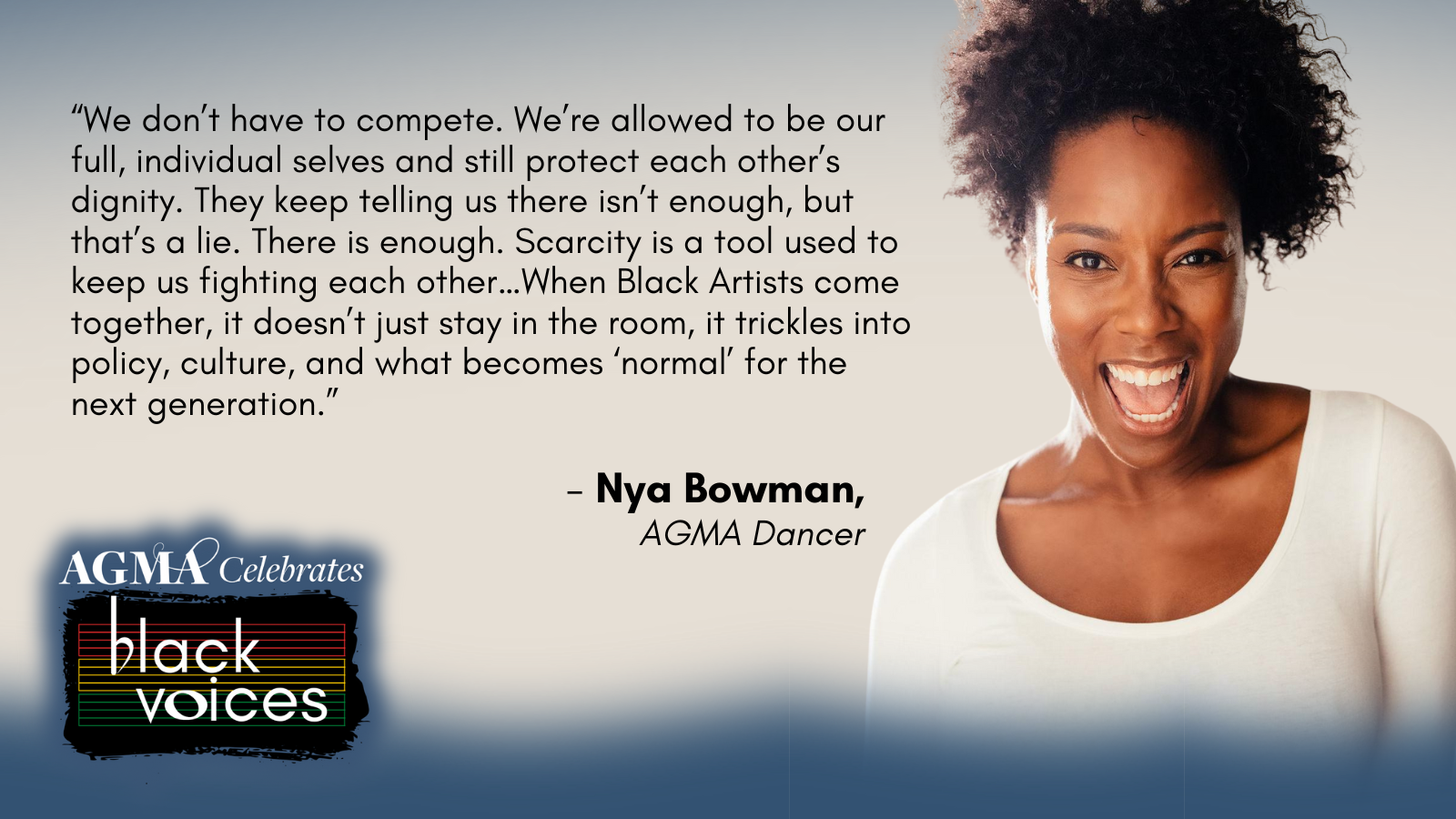
“We don’t have to compete. We’re allowed to be our full, individual selves and still protect each other’s dignity,” she says. “They [the industry] keep telling us there isn’t enough, but that’s a lie. There is enough. Scarcity is a tool used to keep us fighting each other.”
She noticed the pattern of institutions hiring only one Black woman at a time, which fosters competition rather than community. She admits that, early in her career, she often ignored this tension, partly for survival and partly because that was “just how it was.” Her perspective shifted when she saw younger dancers questioning why, instead of accepting harmful traditions as fixed standards. From them, Nya learned the power of naming what was happening in the room, and speaking the quiet part aloud, insisting that competition was not inevitable, and that being an individual did not mean erasing another Black artist. The shift marked a turning point not only in her personal approach but also in how she supports others.
Nya’s renewed understanding of the responsibility Black artists have in every space is rooted in care for those who come after, seeking signs of belonging. As a young dancer, Bowman remembers browsing pictures and websites, asking an unspoken question many Black artists know well: Is this space safe for me? Representation, she believes, answers that question. One of the most significant moments in Bowman’s career came when she became the first Black woman to perform Lamentation, a landmark solo in the Martha Graham repertoire, in the Martha Graham Dance Company’s Italian production of Cercando Picasso.
Nya adds, “I can’t wait for the day when we don’t have to say ‘the first,’ but until then, representation matters.” Bowman sees real change, though not perfect, is happening through collective action. Her work with AGMA in leadership roles and the Union’s Black Caucus has reinforced the belief that solidarity is not just symbolic.
“When Black Artists come together, it doesn’t just stay in the room; it trickles into policy, culture, and what becomes ‘normal’ for the next generation,” Nya affirms.
Conversations lead to policies. Advocacy leads to protections, and when artists organize, culture shifts. And Nya is looking forward to a future where these are a given rather than a demand.
