
Interview written by AGMA Communications Coordinator Eldad (Eldee) Eyimife
For AGMA Soloist Takesha Meshé Kizart-Thomas, a name is more than just a label. The soprano’s name tells a story. Takesha: highly favored. Meshé: Messiah or Savior. Kizart: the firmament, or the force that separates and unites the heavens and the earth, and Thomas, her married name, means “twin.” To Kizart-Thomas, names are a spoken prayer and a reminder of who you are and who you are called to be. Her name carries the weight of legacy and the responsibility for future excellence. She carries that philosophy in everything she does, from the stages of leading opera houses to the Girl Scout troop she leads.
Born and raised in Chicago, Kizart-Thomas grew up in the pews of the Baptist Church, where music extended beyond performance into fellowship. She looks back on family gatherings where her grandfather, Robert Morganfield, would play the guitar and harmonica with her family singing together as a constant reminder of her musical heritage and the blessing and power of voice and music.
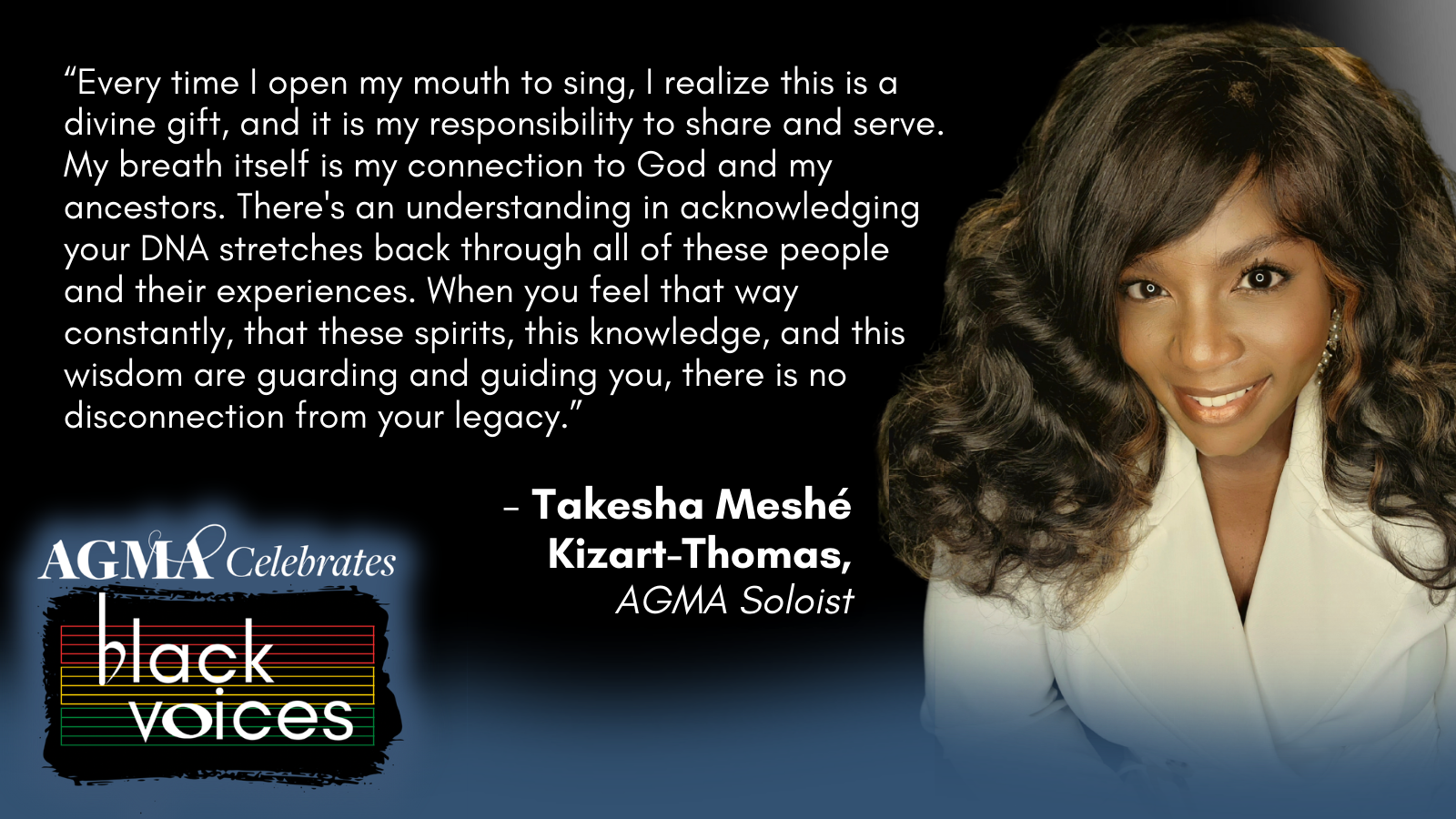
“Every time I open my mouth to sing,” she says, “I realize this is a divine gift, and it is my responsibility to share and serve. My breath itself is my connection to God and my ancestors. There’s an understanding in acknowledging your DNA stretches back through all of these people and their experiences. When you feel that way constantly, that these spirits, this knowledge, and this wisdom are guarding and guiding you, there is no disconnection from your legacy.”
Her singing journey may have started at the tender age of two, but it was at Whitney M. Young Magnet High School that her path to classical music took shape, where a beloved music teacher, the late Mrs. Flora Robinson, was the catalyst for her decision to pursue opera. She recognized Takesha’s vocal talent and nurtured it through voice lessons, competitions, and performance opportunities. From the University of North Texas to a residency at the Academy of Vocal Arts in Philadelphia, Takesha has built a career spanning continents. However, the true moment of excellence that reoriented everything for her was quieter than any stage debut. It was becoming a military wife to her U.S. Coast Guard husband, and mother to their daughter.
“When you have a child,” she reflects, “you go from a place of self to a place of legacy. And you understand that this little amazing being, this awe-inspiring gift, is your responsibility to fill with all that you can: physically, mentally, spiritually, emotionally, monetarily, all of the things.” Her darling daughter is the living, breathing proof of Takesha’s commitment to cementing her legacy and that the next generation is paying attention. “Children are very concerned about the world they’re being left,” Kizart-Thomas says softly. “It is our responsibility to make it better. Not worse. And if we’re not living up to that calling, we have failed.”
That sense of obligation does not stop with her bloodline. As founder of The Meshé Legacy, Takesha has articulated a mission to publish, produce, and perform visionary multidisciplinary works while cultivating the leaders who create them, bridging the gap between artistic innovation and accessibility to inspire a more creative and thoughtful global community. Her five core values are excellence in artistry, visionary innovation, diverse storytelling, empowered leadership, and an enduring legacy that, as she puts it, is “healthy, wealthy, and wise.” Recently accepted into a Global Arts MBA program in Arts Innovation, she is sharpening the tools to bring that vision to full scale, including a Young “Artistpreneurship” Incubator designed to give emerging performers the business literacy that conservatories so rarely provide.
She recalls an experience where she saw the true value of presenting excellence. After her debut performance of Tosca with the Dallas Opera during one of the school performances, she lingered near the exits, overhearing some of the girls singing, repeating the sounds she made, and visualizing themselves on stage. “They understood that they could be me,” she says, “and I was them.” That is the through line of everything she builds: the knowledge that representation, delivered with uncompromising excellence, plants seeds that bloom in generations you may never meet.
Our grandparents, she reminds us, labored for things and ideals they knew they might never see the fruits of. The legacy work. And now, every time Takesha Meshé Kizart-Thomas opens her mouth to sing, speak, and lead with the faith of God in her bones, ancestors at her back, and her family watching from the wings, she does it for them, for the hope of continuing a legacy of excellence for generations to come.