
Interview by Eldee Eyimife, AGMA Communications Coordinator
AGMA Dancer Sarah Gabrielle Ryan considers herself lucky to have grown up so close to the Philadelphia Ballet (formerly Pennsylvania Ballet). Through their performances, she found inspiration in icons like Ríoama Lorenzo and Arantxa Ochoa and a passion for ballet. She went from seeing them on stage to learning directly from her role models, speaking Spanish with them during rehearsals. That early connection stayed with her throughout her career, shaping nearly everything Sarah has done since, as a dancer with Pacific Northwest Ballet (PNB) and as a longtime AGMA delegate.
Now in her 11th season with Pacific Northwest Ballet, Sarah has spent much of her career noticing where gaps existed and working to correct them. Over the years, she has found various ways to expand Hispanic representation at her company and in her community.
A few years ago, Sarah and her husband, fellow PNB dancer and choreographer Kyle Davis, helped launch a series of Heritage Month open houses at the company—small events that invite the local community into a space many of them had never felt welcome without a ticket. The first honored Holocaust Remembrance Day and brought in nursing home residents and members of local Jewish community centers. It was a hit and led to the next open house, which celebrated Hispanic Heritage Month, drawing on the company’s own dancers for a short performance Sarah choreographed herself, followed by a community discussion panel.
“We’ve been trying to create representation for ourselves,” she says. “It was really cool to see how many people in the community don’t always feel an immediate connection to the Arts. Just inviting them into our studio space for free let them see that we’re here, and they’ve since started coming to our performances.”
The open houses were only the beginning. Drawing on her own family’s history, Sarah co-choreographed a full-length ballet with Davis inspired by her family’s hometown in Mexico, with a pas de deux excerpt that premiered at the PNB School in 2025.
That dedication followed her as she took on Maria in West Side Story—the first big role where she could showcase her Hispanic heritage.
For Sarah, the drive to create space for others is inseparable from her years as an AGMA delegate, a role she held for about six years before stepping back recently. She traces that instinct partly to her upbringing in a Mexican household, which she describes as warm, communal, and built around the idea that everyone is welcome.
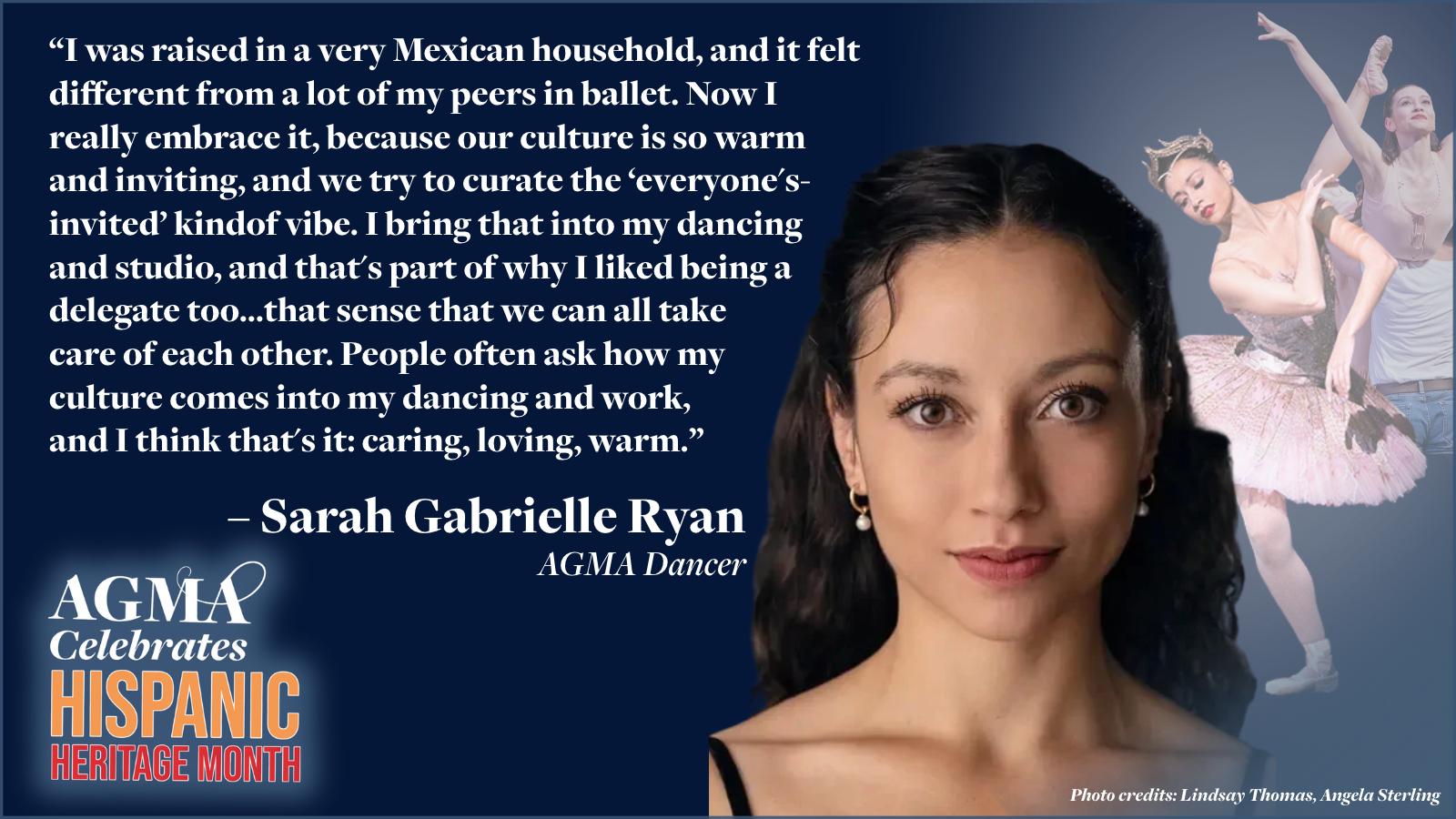
“I was raised in a very Mexican household, and it felt different from a lot of my peers in ballet. Now I really embrace it, because our culture is so warm and inviting, and we try to curate the ‘everyone’s-invited’ kind of vibe,” Sarah explains. “I try to bring that into my dancing and studio, and that’s part of why I liked being a delegate too… that sense that we can all take care of each other. People often ask how my culture comes into my dancing and work, and I think that’s it: caring, loving, warm.”
Sarah excelled at organizing colleagues at PNB, talking to leadership, and turning an idea into something the company would actually support. The open houses and the original choreography she has since staged didn’t happen because someone opened a door for her; she built it herself, using the same advocacy muscles she’d developed fighting for her fellow dancers’ contracts and working conditions.
Sarah is quick to credit her family with instilling that resolve long before she became a delegate. Her mother grew up dancing ballet folklórico in Mexico and first brought Sarah to ballet. Her parents went to extraordinary lengths to support her career, with her father taking on a third job and her mother leaving a full-time position to become a part-time medical interpreter to keep Sarah’s schedule flexible enough for rehearsals.
“They did everything in their power to make sure I could do this,” she says.
That foundation of advocacy—instilled early by her family, then sharpened through years as a delegate—is what Sarah now hopes to pass on to the next generation of dancers.