
As part of AGMA’s Women’s History Month Spotlight series, AGMA Staff Member Alejandra “Ale” Vega Rosas speaks with Communications Coordinator Eldad (Eldee) Eymife about the life and legacy of her son, AV. Her story is one of advocacy, resilience, and unimaginable loss. Ale describes how, in the face of grief, she continues to carry forward a spirit of compassion in her work and within the AGMA community.
AV Rosas radiated warmth by every account. Highly intelligent, deeply empathetic, and full of life, he could walk into a room of strangers and leave with friends. But from a very young age, AV also carried a heavy burden.
Diagnosed with schizoaffective disorder, ADHD, and mood swings, AV navigated a childhood shaped by impulsivity and a school system ill-equipped to support him. His mother, Alejandra “Ale” Vega Rosas, an AGMA staff member, became his fiercest advocate. She attended every Individualized Education Program (IEP) meeting, moved him from school to school to escape the “bad kid” label.
“My son’s name was Adrian Victor Rosas, but we called him AV,” Ale shares. “He was a sweetheart, like a big teddy bear, sweet and kind. His illness did not define who he was. AV loved his family. He always remembered birthdays: mine, his dad’s, his sister’s, and when my granddaughter was born, he became ‘Uncle AV’ and absolutely adored her.”
AV tragically died on May 23, 2013, from complications of a diabetic coma at just 24 years old. The years of cycling on and off prescribed medications and self-medicating with drugs and alcohol had taken a devastating toll on his body. For his mother, the loss was not only of her son, but of all the promise and life he had yet to live.
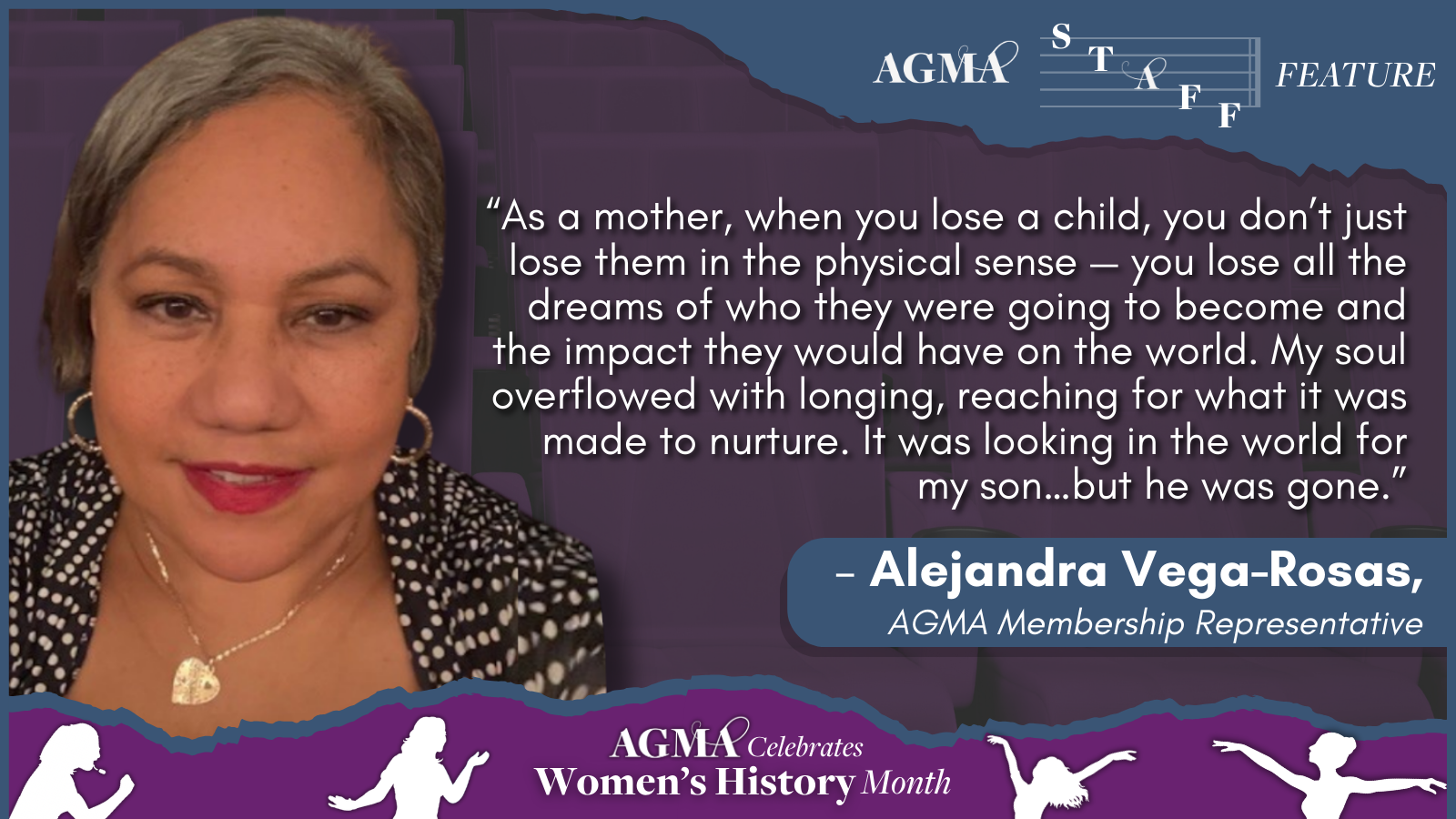
“As a mother, when you lose a child, you don’t just lose them in the physical sense — you lose all the dreams of who they were going to become and the impact they would have on the world. My soul overflowed with longing, reaching for what it was made to nurture. It was looking in the world for my son…but he was gone.”
The grief rippled outward. Her marriage — 43 years strong, childhood sweethearts — nearly broke under the weight of grief. Friends she had counted on disappeared, unable to find words equal to the moment. She found herself in some of the darkest places of her life, including a night when she sat with pills in front of her, and called her husband before it was too late. “I almost drank myself into oblivion,” she reflects. “But God and my family helped me through.”
In the days following AV’s death, Alejandra made a decision that she felt was entirely true to who her son was: she donated his organs.
“Giving forward was simply who AV was; he was always helping people.. One of the donors wrote to thank me. He couldn’t play with his grandchildren, but because of AV’s kidney, he was able to spend time with them and play. I resonated with that deeply because I have a grandchild.”
She keeps AV alive in the everyday rhythms of family life. On his birthday, there is always a chocolate cake, his favorite. His photographs line the hallway of her home. Every year on May 23, the family gathers to remember him. “Some days it feels like it just happened,” she says. “But I can honestly tell you that I am not the same person I was on May 22, 2013. There’s a hole in my heart that can’t be refilled. Grieving parents can live on, but it’s never quite the same.”
Now, a part of the Union’s professional staff, Alejandra was working at the AGMA Retirement and Health Fund Office when she lost AV. She praises the personal support of her AGMA colleagues and members. When she was struggling, they showed her grace and understanding until she could get back on her feet. That grace is something she now tries to extend to every AGMA member she serves — showing up for them the way her colleagues showed up for her, and the way she always wished the world had shown up for AV.
“There were times I was on the train to work, and I’d have a panic attack — just break down crying — and have to call my boss: ‘I can’t come in.’ Imagine sitting at your desk, trying to work, and all you can see is your child’s face.”
Losing AV did not diminish her sense of motherhood; in fact, it deepened and transformed it. Where she once understood motherhood as raising children toward a future, she now understands it as something far more fragile and sacred: the act of loving fully, in whatever time you are given. She is candid that she probably “suffocates” her daughter Alexis a little, checking in every week without fail. But she does not apologize for it. Losing a child, she says, made motherhood mean more to her than anything else in the world. It also taught her that motherhood does not end with death. AV remains her son, his name still spoken, his story still worth telling.
“Losing AV made motherhood mean more to me than anything else in the world. Holding on to my daughter feels so precious. So I tell all the parents around me, ‘Don’t stay angry at your kids. Don’t go long periods without talking to them. Tomorrow is not promised. Treasure your children. Love them. Be part of their lives every moment you can.’”