
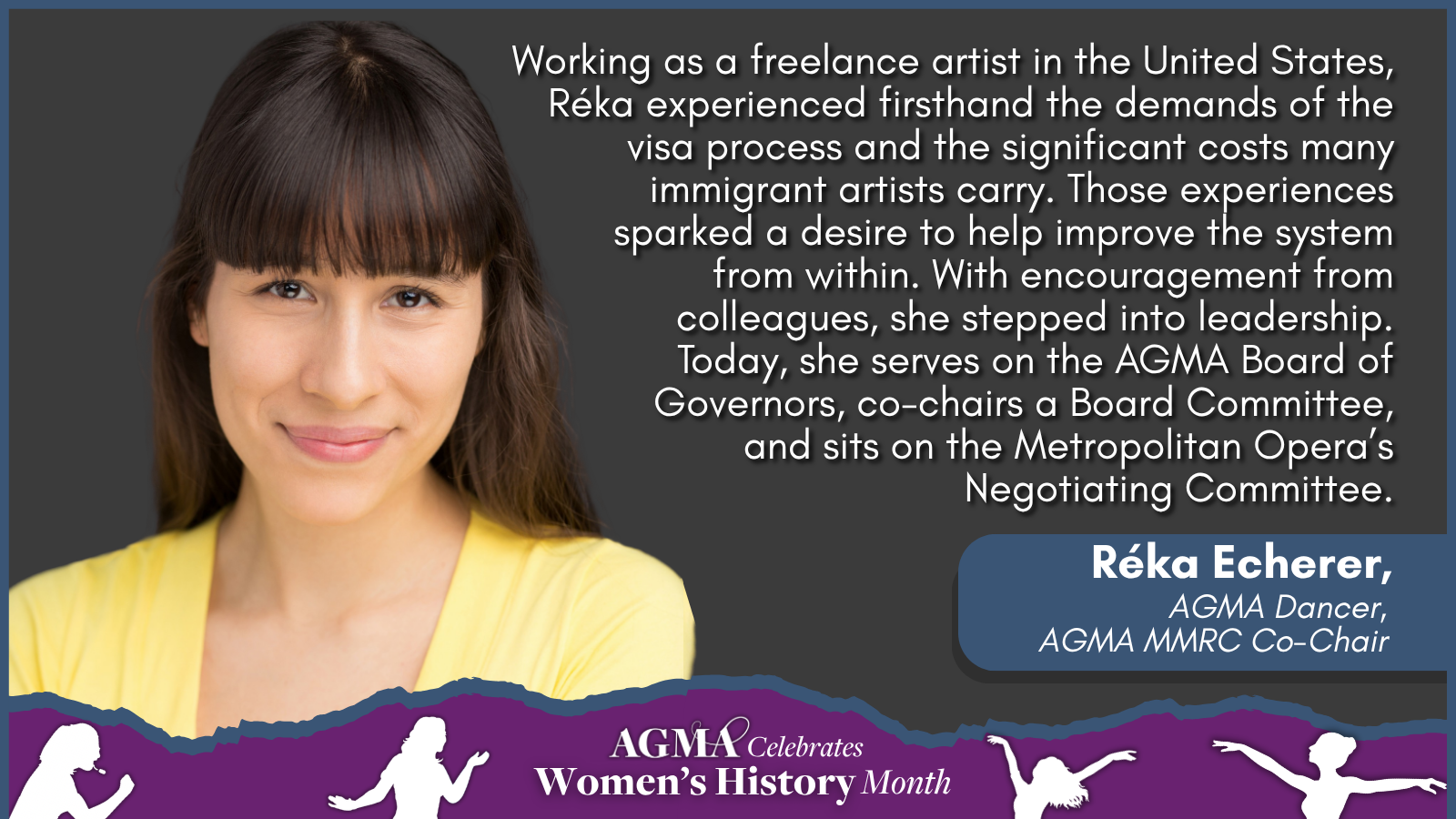
In this Women’s History Month Spotlight, AGMA highlights Board Member and Dancer Réka Echerer, whose journey from childhood to the stage of the Metropolitan Opera has been guided by the women in her life. In an interview with AGMA’s Communications Coordinator, Eldad (Eldee) Eyimife, she speaks about mentorship, migration, and her work as an AGMA leader pushing for a more equitable and inclusive industry.
Today, Réka Echerer dances at the Metropolitan Opera. She grew up watching her mother perform and learning ballet positions from her grandmother. By age six, she pleaded to begin formal ballet classes. Her mother, a performer-turned-activist and European Parliament member, made her contemplate for a full year before allowing her to take her first class, not wanting ballet to be something borrowed, and teaching her early that desire without commitment meant nothing. Her grandmother was a second mother, taking her to work on farms in Romania each summer and teaching her that hard work and beauty can coexist, values she carried into every rehearsal and performance. These two women gave Réka a solid foundation, and she stepped onto her first professional opera stage at just 11, as a student at the Vienna Opera Ballet School. While there, Réka was cast in productions such as Tales of Hoffmann, Carmen, Tosca, and The Magic Flute alongside artists who would go on to become legends.
“Looking back now, I realize what performing at a young age truly taught me was how to perform in a big house,” she says. “That’s not something you necessarily learn in dance school or conservatory. There’s a real difference between performing in a 4,000-seat house like the Metropolitan Opera and other venues. What it taught me was to be a small part of a bigger machine, and how valuable that was. I personally love that.”
That lesson stayed with her when she left Vienna at 15 for a summer dance program in Virginia and ultimately never returned, after receiving a scholarship to stay. She was placed with a host family whose warmth made a foreign country feel like home. Her host mother cooked her breakfast every morning, drove her to dance class, and welcomed her as one of their own. It was a generous beginning to what would prove to be a complicated journey, because as Réka would learn, immigration is not a single hurdle. It is a constant, ongoing negotiation with systems that do not always act in good faith.
Working as a freelance artist in the United States, Réka experienced firsthand the demands of the visa process and the significant costs many immigrant artists carry. Those experiences sparked a desire to help improve the system from within. With encouragement from colleagues, she stepped into leadership. Today, she serves on the AGMA Board of Governors, co-chairs the Membership and Member Relations Committee (MMRC), and sits on the Metropolitan Opera’s Negotiating Committee.
“This is something we have to change from within. How do we make immigrant artists feel welcome and valued in our union? Those are the questions I take very seriously, and I know it takes time. What’s really exciting now is that, a couple of years into this, I’ve seen a positive shift. I’m here for the long haul, and I always encourage other immigrant artists to join union leadership so I’m not alone in advocating on these issues.”
Her advocacy extends beyond migrant workers’ rights to include celebrating women’s sensuality on stage. Growing up on professional stages meant growing up inside the stories those stages told about women. She noticed that female sensuality was too often flattened into spectacle. As a young artist, she took those roles because she wanted to work, but with experience came sharper questions: “What does this level of nudity add to the story? Is this characterization of women aligned with what I believe?”
After a decade at the Met, she carries these questions into every rehearsal room. She pushes for what she knows can shift the whole equation: more women directing, more women choreographing, more women in every room where the stories get decided.
“I love being a sensual, expressive woman, and I celebrate everyone who feels empowered in that,” she says. “But when it’s the only thing being asked of you, I want to push back and say, ‘I can bring more to this. I can make it more complicated and more interesting.’ As a performer, I always ask myself whether the way I’m portraying womanhood aligns with what I believe. If it isn’t, I might pass on the opportunity or find a way to shape the experience so everyone feels safe and empowered. In the end, I want women to feel fully empowered wherever we are, in whatever workspace, and to be able to show up as themselves.”
Throughout her life and career, the women in her life have provided clarity and direction. Her mother who modeled conviction and creative ambition in equal measure; her grandmother, whose jewelry she still wears and whose spirit she carries into every room; her host mother in Virginia, who made her feel seen before she even knew what she was looking for; the women who shared stages with her, dressing rooms, and long waits in the wings, and acts of encouragement across decades.
“The female friendships I’ve built everywhere in the world are what truly kept me going and made me who I am, especially because I was so far from home for so long,” she shared. “When you’re away from home, your friends become your chosen family. I’m so grateful for the technology that lets us stay connected, because those friendships made me who I am today.”
That is, in the end, the essence of Réka Echerer’s story: a woman raised by women, and determined to shape something better for the women who come next.