
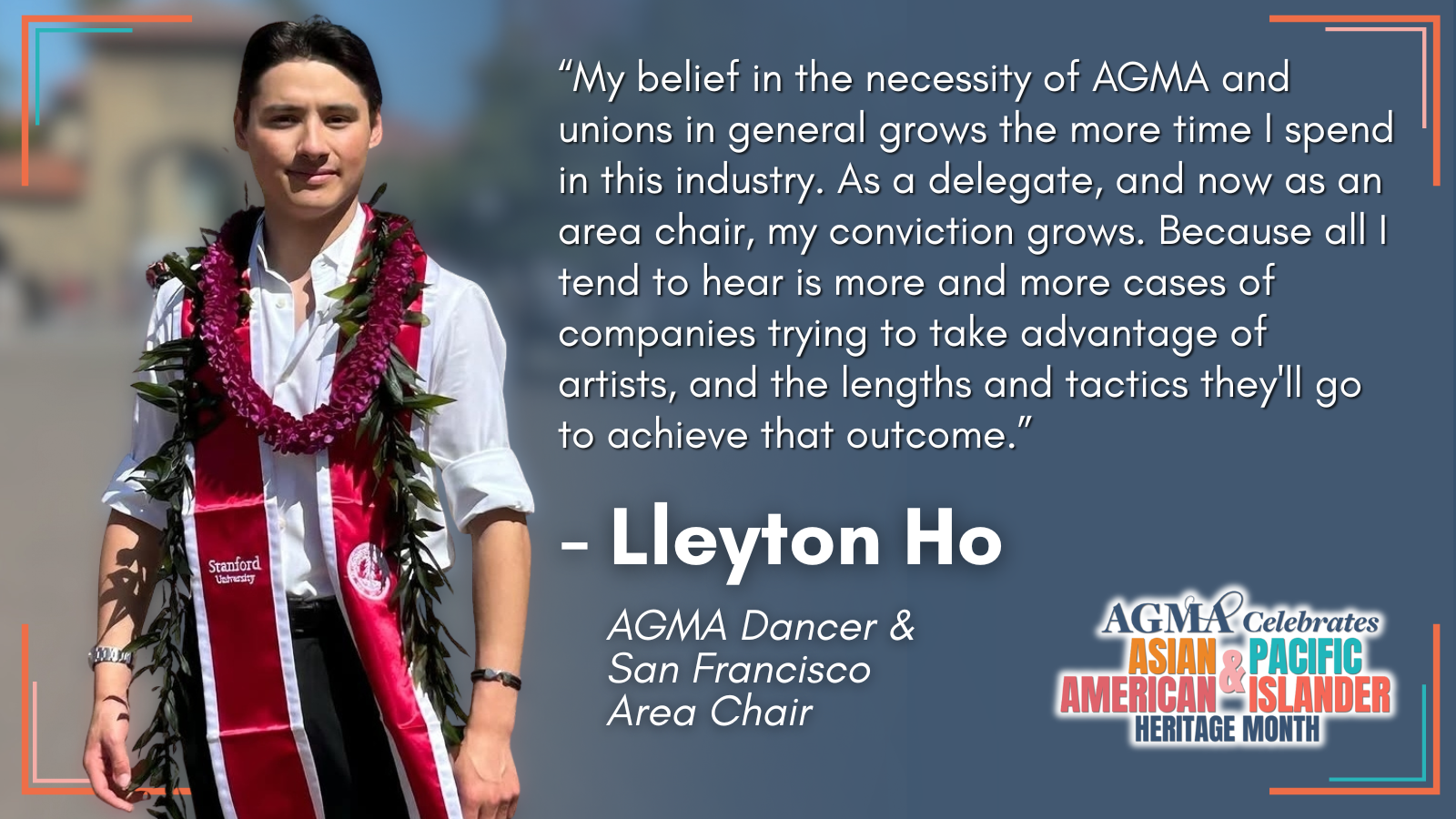
At just 18 years old, he was faced with an impossible decision, one most teenagers don’t have to consider. He had been accepted to Stanford University. And Helgi Tomasson, then artistic director of SFB, had offered him a contract.
“When both things worked out, I was left in a major conundrum. Tell any dancer you turned down a contract at SFB, and they’re going to look at you and say, ‘Are you nuts?’,” he recalls. “Tell any person you turned down your acceptance to Stanford, and they’ll say the same thing. Both reactions are completely valid.”
Lleyton’s parents — his father, a first-generation Korean American, his mother, an Irish American — emphasized the importance of academics and the need for a backup from an early age. As a result, he took the SATs, wrote his college essays, and applied to Stanford as a contingency, never quite expecting it to become a tangible option.
He decided to jump into both opportunities. How he was able to manage a courseload and dance full-time was broken down in an interview with Dance Magazine: “Thanks to surgically precise scheduling and a hefty dose of determination, Ho graduated from Stanford this past spring with an economics degree. He spent the previous three years balancing San Francisco Ballet’s 45-week contract with 8:30 am economics lectures, commuting 35 miles from campus to studios.”
His work ethic and ability to manage both academics and the performing arts are something he traces directly to his family. His paternal grandfather immigrated from Korea as one of eleven siblings, the first to come to the United States, and eventually sponsored nearly all of them to follow.
“I know I fall into some of the stereotypical Asian workaholic tendencies, but so do my parents, so it’s really just a learned trait at this point. It’s an identity that underscores almost everything I do, and one I’m very proud of. It actually became a lot stronger after I moved to San Francisco.”
His drive not only transferred into his art but also into his union work. Lleyton has served as a delegate at SFB since his earliest years with the company, and last year became the AGMA San Francisco Area Committee Chair, a role focused on organizing, advocating for members, and working to address concerns across companies in that Area, including San Francisco Opera, San Francisco Symphony, Sacramento Ballet, and Nevada Ballet Theatre, among others.
“My belief in the necessity of AGMA and unions in general grows the more time I spend in this industry,” he admits. “The more time I spend working as a delegate, and now as an area chair, the more my conviction grows. Because all I tend to hear is more and more cases of companies trying to take advantage of artists, and the lengths and tactics they’ll go to achieve that outcome.”
Growing up in New York, he moved between his Korean and Irish sides without giving either much conscious thought. Moving to San Francisco shifted something. The city’s Asian community felt more present, more accessible, and easier to connect with. He met more Hapa peers. People recognized his last name. The Korean side of his identity, which had always been there, came more fully into focus.
The Asian representation he saw extended past the streets of San Francisco to the stages he performed on. SFB has long had a strong presence of Asian and Asian American dancers, a contrast Lleyton noticed immediately after years at a company where Asian men were a rarity. He grew up watching Korean operas at his grandparents’ house, and that was the most representation he had seen on stage until he moved.
“Moving to San Francisco and seeing that shift, being surrounded not only by Asian Americans but also by Asian dancers more broadly, made a real difference in how much I enjoyed the workplace and how welcome I felt there. The Korean operas at my grandparents’ house were something different — more of a door into my family’s past, into the culture my grandparents left when they came here. And then seeing SFB for the first time, and eventually coming here to dance… it wasn’t that the stage suddenly felt more accessible…but that the other half of my identity, my Asian side, also felt meant for the stage.”
Lleyton Ho looks forward to the union and dance work ahead of him and a longer-horizon goal: to retire one day and leave behind a stronger SFB contract than the one he inherited. His message to the next generation is equally direct: “Stay in school, because you genuinely do not know where it will take you, and don’t let management intimidate you. The union exists for a reason, and it fights as hard as it does for a reason. The harder everybody fights, the better the next generation is going to have it. Until then, there is work to be done — at rehearsals, in negotiations, and on stage.”