
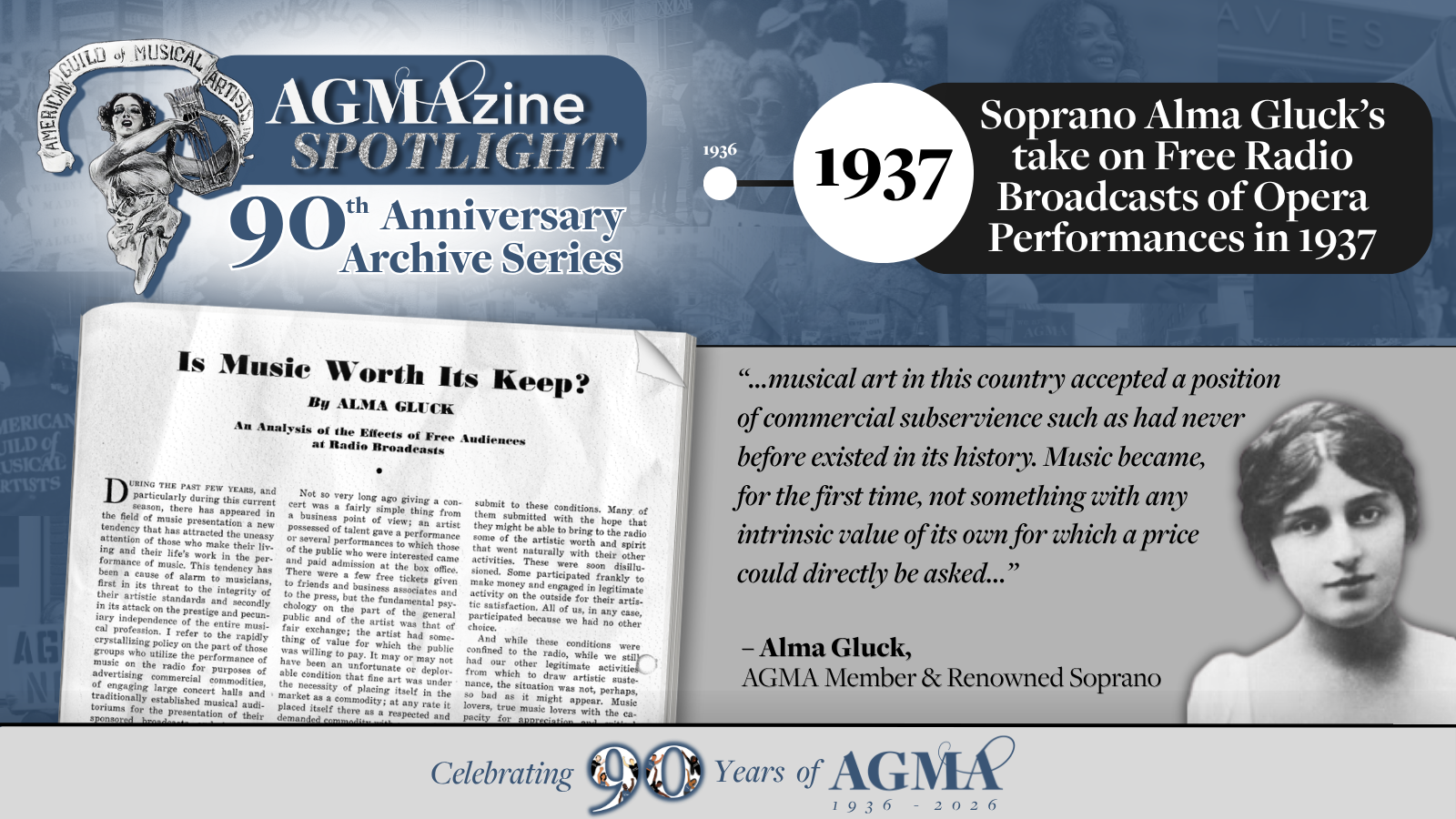
During the Great Depression, opera companies faced shrinking audiences and the urgent question of how the art form could survive and reach people amid a time of economic hardship.
In response to this need, the Metropolitan Opera partnered with the National Broadcasting Company to launch regular radio broadcasts, beginning with a 1931 transmission of Hänsel und Gretel. For the first time, opera reached listeners across the country, free of charge, expanding access in ways unimaginable just a decade earlier.
But even as this innovation opened doors, it raised urgent questions that still resonate today, like, What is the value of an artist’s work in a rapidly changing media landscape? And who gets to define it?
Years later, in 1937, AGMA member and renowned Soprano, Alma Gluck, gave voice to those concerns in the pages of AGMAzine, warning that the growing influence of sponsored broadcasts risked reducing artistry to a tool for commercial gain. 90 years later, conversations like this one from 1937 continue across streaming platforms, digital performances, and new models of audience engagement. The landscape has changed, but the core questions remain strikingly familiar.
Here are some excerpts from her piece:
“There has appeared in the field of music presentation a new tendency that has attracted the uneasy attention of those who make their living…in the performance of music. This tendency has been a cause of alarm to musicians… in its threat to the integrity of their artistic standards…”
“…musical art in this country accepted a position of commercial subservience such as had never before existed in its history. Music became, for the first time, not something with any intrinsic value of its own for which a price could directly be asked…”
“If we allow them (the audience) to become accustomed to seeing…for nothing as the guests of commercial sponsors, we cannot but expect them to refuse us their recognition as independent business people. When that happens, we must ask ourselves if we have a right to demand their recognition as artists.”
You can explore this issue, along with all issues of AGMAzine, in the AGMAzine Archives on our website.