
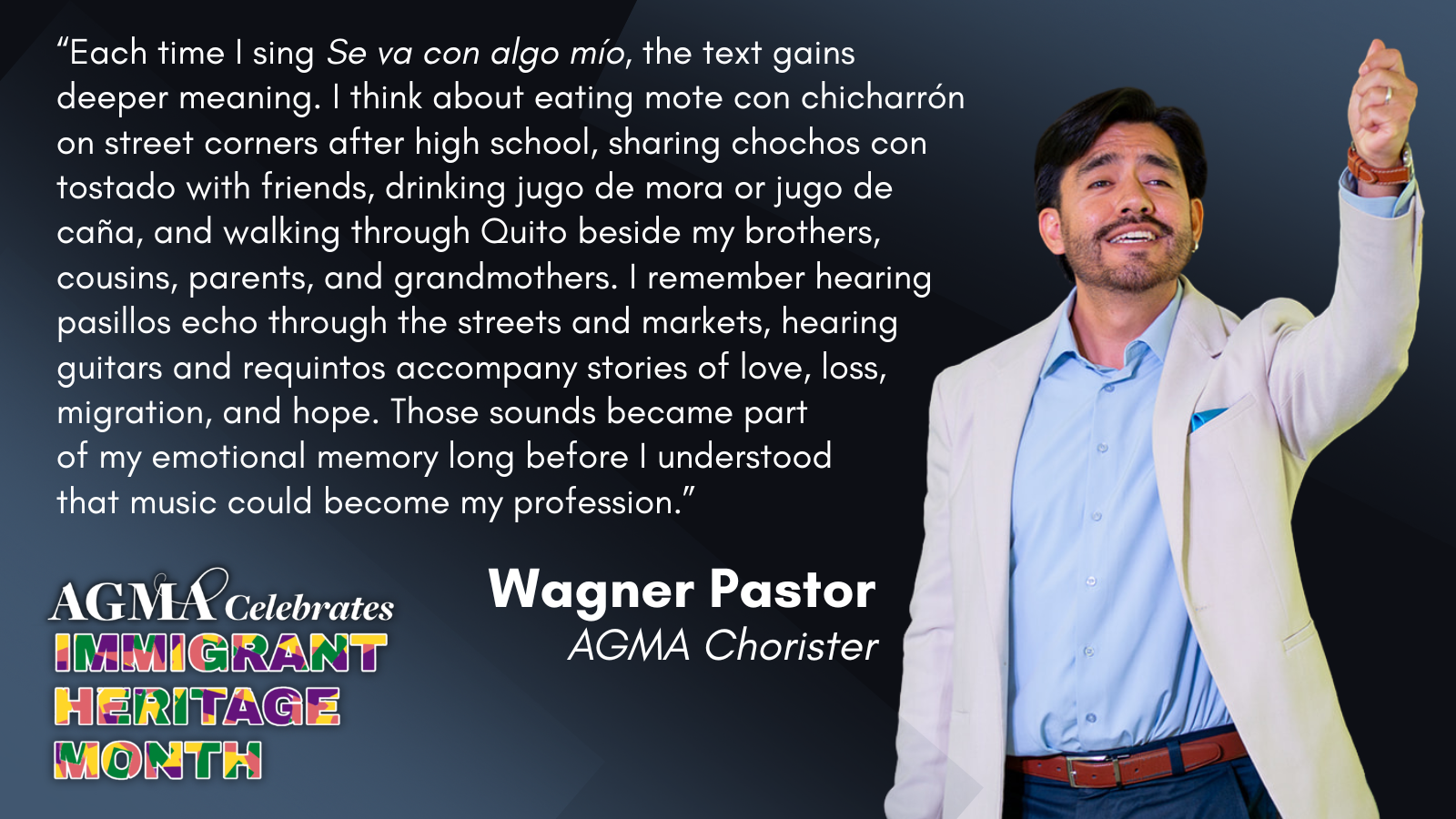
By Dr. Wagner Mauricio Pastor, AGMA Chorister
A few months ago, I had the opportunity to present a lecture recital at the University of Texas at El Paso and at Lone Star College-Cypress in Houston, alongside my wife, soprano Andrea Salazar, and others. Together, we performed Latin American repertoire from Ecuador, Argentina, Mexico, Perú, and other countries connected to our identities and artistic journeys. Among the works on the program was Se va con algo mío by Ecuadorian composer Gerardo Guevara and poet Medardo Angel Silva, one of the most beloved Ecuadorian pasillos.
A few hours later, we listened to mariachi group, Los Mineros, perform on the same stage. Sitting in the audience, I held my breath and bit my tongue to keep from crying. In that moment, I felt the full reality of what it means to live as a migrant artist in the United States, carrying your homeland within you while building a life far from it. The sound of guitars and voices filled the hall, and suddenly, memories from my childhood in Ecuador began flooding my mind. I thought about how far life had brought me from the streets of Quito to a concert hall in Texas or New York, sharing music that represented not only my country, but also my identity, my family, and my history.
It has been almost 15 years since I left Ecuador to follow my dream of becoming an opera singer. When I first arrived in the United States, I carried the same hopes as many immigrants. I desired to grow, to study, to create opportunities, and to honor the sacrifices of the people who believed in me. Like many young artists, I did not know exactly how difficult the road would be. There were moments of uncertainty, financial struggles, loneliness, cultural adjustment, and the constant pressure of proving that I belonged in spaces.
Music became the bridge between my past and my future. It became the language that allowed me to preserve my roots while adapting to a new country. Every aria, every rehearsal, every audition, and every performance carried traces of the life I left behind in Ecuador with my brothers Diego and Carlos, my nephew Camilo, my mother Maria, my father Juan, and my beloved grandmothers Bachita and Nelly.
I met my wife during the pandemic through an online educational initiative we helped create for singers in Ecuador. Together, we worked as founders, recruiters, organizers, and translators, connecting Ecuadorian students with internationally recognized artists and educators. At the time, my wife and I were young artists dreaming about studying, performing, and building lives in opera. We understood the challenges because we had lived them ourselves.
That experience reminded me how important mentorship and access can be for immigrant and international artists. Many talented musicians in Latin America possess extraordinary talent, but opportunities are not always equally accessible. Sometimes all a young singer needs is someone to say, “Your voice matters. Your story matters. You belong here. You have the potential.”
As I approach my 35th birthday, I reflect on how much music has transformed my life. I still cannot fully believe that I have had the opportunity to be part of the American Guild of Musical Artists (AGMA) and perform with companies like Cincinnati Opera, Kentucky Opera, Opera Saratoga, and, soon, Houston Grand Opera. For someone who once dreamed of these possibilities while walking through Quito as a teenager, these moments feel both surreal and humbling.
Yet success as a migrant artist often comes with complicated emotions. There is gratitude, but also nostalgia. There is accomplishment, but also distance from home. Every achievement carries memories of the people and places that shaped you.
Each time I sing Se va con algo mío, the text gains deeper meaning. I think about eating mote con chicharrón on street corners after high school, sharing chochos con tostado with friends, drinking jugo de mora or jugo de caña, and walking through Quito beside my brothers, cousins, parents, and grandmothers. I remember hearing pasillos echo through the streets and markets, hearing guitars and requintos accompany stories of love, loss, migration, and hope. Those sounds became part of my emotional memory long before I understood that music could become my profession.
Today, when I perform Ecuadorian repertoire at universities and theaters across the United States, I feel I am carrying those memories with me onto the stage. I am not only singing notes and words; I am sharing pieces of my homeland and honoring generations of artists and families whose stories deserve to be heard, from the Incas, Kitus, and my Mestizo identity.
For me, migration and music are inseparable. Music has allowed me to survive moments of uncertainty, celebrate moments of joy, and remain connected to my cultural identity even while living far from home. Through opera and Ecuadorian art song, I hope to continue amplifying Hispanic voices and bringing Latin American repertoire to stages where it has historically been absent.