
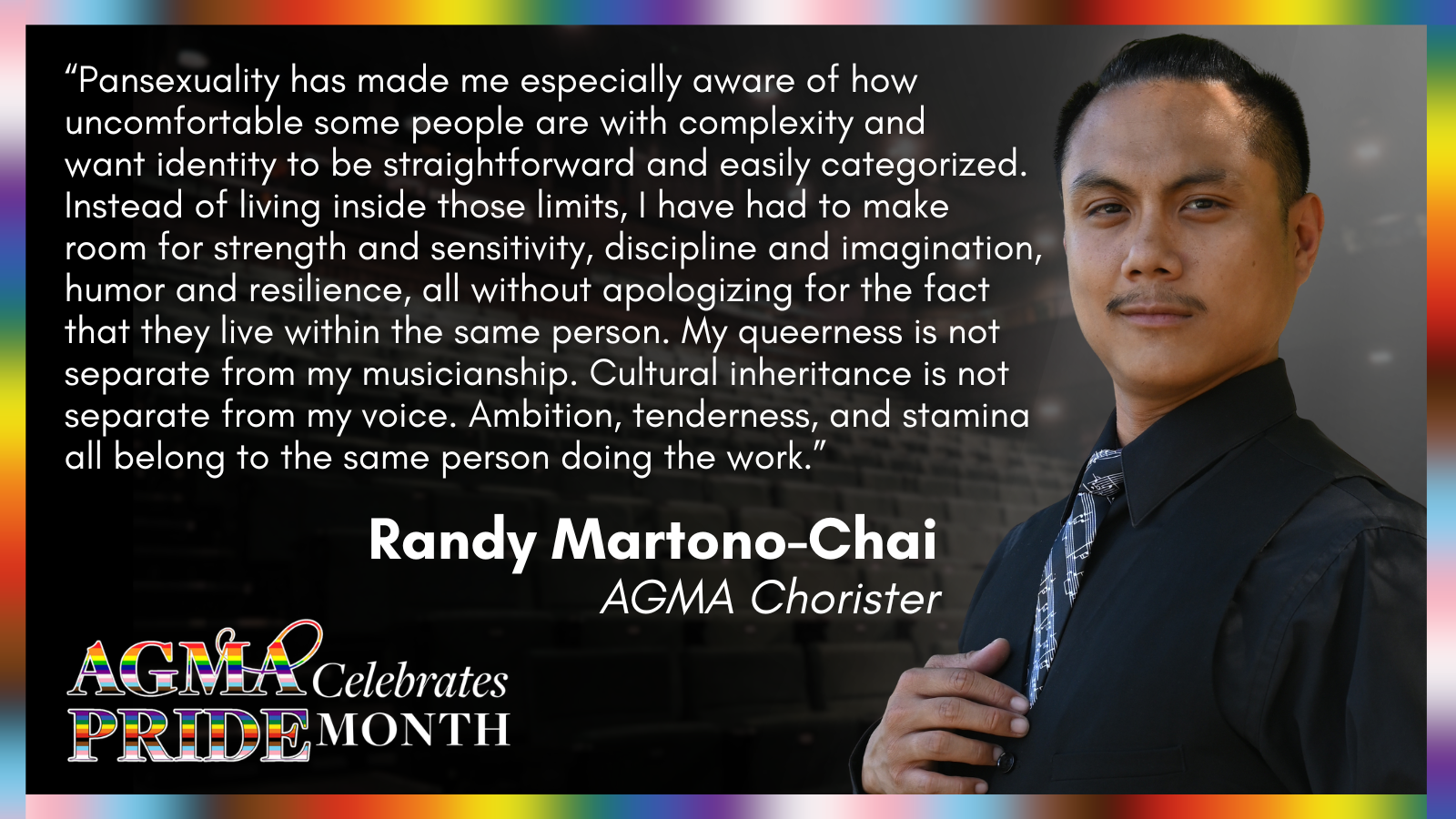
By Randy Martono-Chai, AGMA Chorister
Music has always been the place where my many worlds could speak at once. Growing up in multiple cultures informed my upbringing and gave me a global perspective before I had the language to explain it. Long before I understood every part of myself, I began learning that sound, rhythm, language, and feeling could all belong together. I started piano at three and later expanded into flute, voice, organ, conducting, jazz, theatre, and songwriting.
I move between many spaces across my professional life: opera, theatre, worship, jazz, commercial music, education, accompaniment, music direction, and my own creative work as Randy MC. Every stage, rehearsal room, sanctuary, classroom, and studio requires a different part of me, yet draws from the same artist. Every aspect of my work, and by extension, myself, goes beyond surviving misunderstanding and seeks to keep creating, leading, and doing beautiful work.
For years, words of hate have been thrown at me both in person and online. Such words were meant to shame my queerness, my brown skin, my Asian background, and the parts of me that did not fit someone else’s narrow idea of manhood. Bias can come through a glance, a joke, a comment, a slur, or a decision about who belongs in the room. Experiences like these teach you how much energy it can take simply to remain present, composed, and excellent in spaces where others may already have decided what they think they see.
Performance work can also measure people against a narrow physical ideal. Film, Broadway, and regional theatre can create pressure to be tall enough, masculine enough, white enough, or immediately legible enough for someone else’s idea of a role. As a cisgender man who is also pansexual, Asian American, and brown-skinned, I know what it feels like to wonder whether I am being seen for my craft or perceived through assumptions.
Opera has offered me a space where the focus can return to the voice, the preparation, and the craft. Standing only feet away from Grammy- winning musicians, I have felt the honor of being there because I could do the work at a professional level. Receiving that recognition and having my voice taken seriously matters.
Pansexuality has made me especially aware of how uncomfortable some people are with complexity and want identity to be straightforward and easily categorized. Instead of living inside those limits, I have had to make room for strength and sensitivity, discipline and imagination, humor and resilience, all without apologizing for the fact that they live within the same person. My queerness is not separate from my musicianship. Cultural inheritance is not separate from my voice. Ambition, tenderness, and stamina all belong to the same person doing the work.
For me, Pride is not only visibility. Visibility alone is not enough if people are still flattened into stereotypes, tokenized, or asked to make themselves smaller. Wholeness is the real demand. It means bringing my queerness, culture, sensitivity, strength, contradictions, and voice into the work without apology. I want that not only for myself, but for the wider LGBTQIA+ community: to be seen, embraced, and celebrated as part of ordinary human culture rather than pushed to the margins as exceptions.
Music constantly asks us to listen more deeply. Pride Month asks the same of our communities. As a pansexual, Asian American artist, I carry that meaning into every room I enter. For me, it is not a slogan, but a commitment to dignity, authenticity, and the full humanity that makes art possible.