
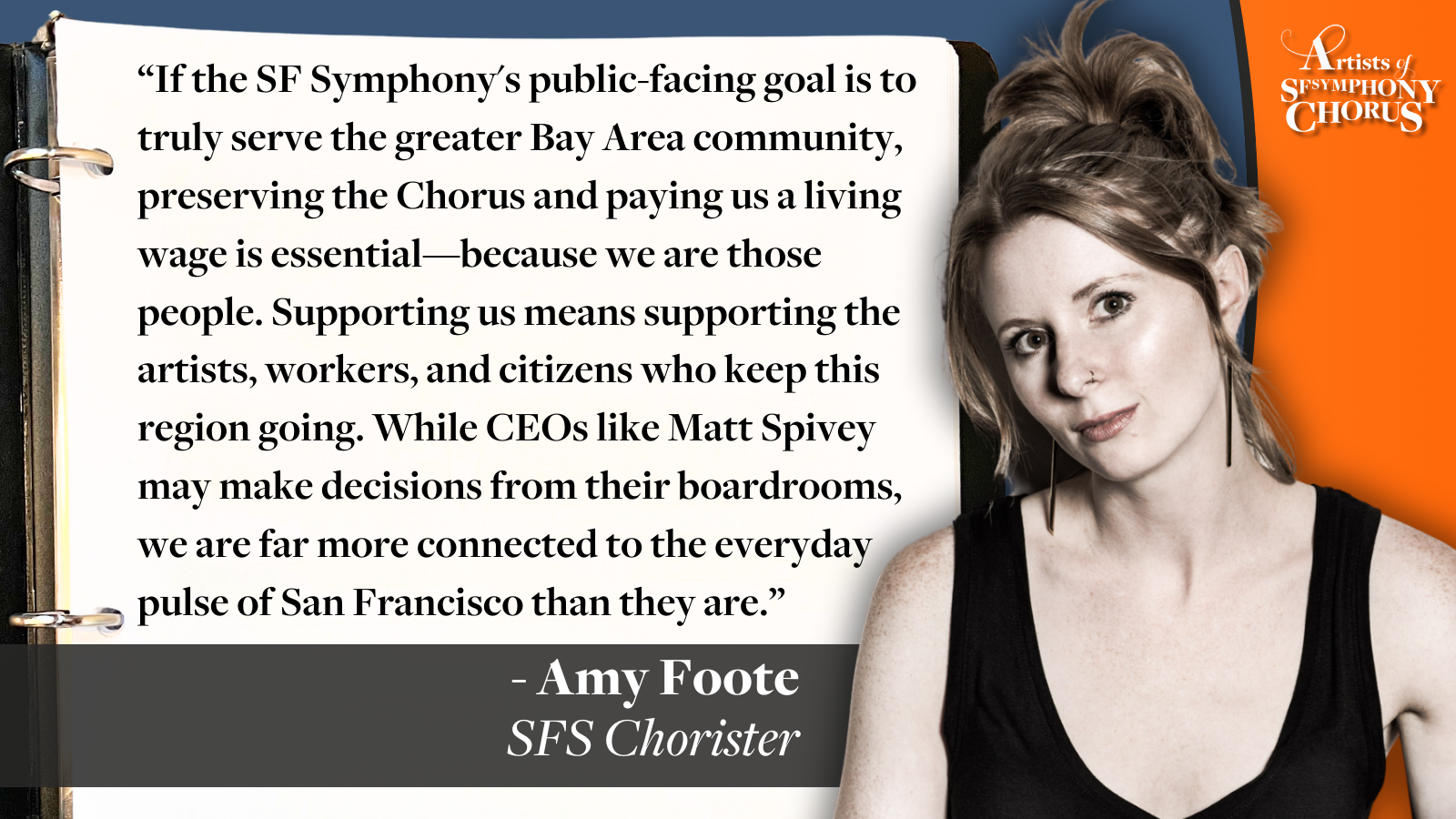
Singer Amy Foote explains how the ripple effect of these proposed cuts goes far beyond the Symphony—it reaches into the heart of San Francisco’s daily life.
Being a musician takes you to some unexpected places. Since graduating with my Masters degree in Vocal Performance nearly 15 years ago, I have sung onstage with Third Eye Blind, opened for Moby at South by Southwest, and have been on the same lineup as Bjork at a tech and genetics conference in the South Bay. I have also hung out with nervous elementary school kiddos in a public school as they prepared backstage for their first-ever performance alongside myself and my San Francisco Opera A La Carte colleagues, coached a trans woman on how to speak more healthfully and freely with her changing voice in my home studio and spent an afternoon running a karaoke session with long-term dementia-ward residents at Laguna Honda Hospital.
Then, sometimes, I find myself sitting across the table from management at the San Francisco Symphony in high-pressure contract negotiations, trying to convince them that my job as a singer in the chorus is valuable and should be paid a decent wage. (Mind you, when I say “a decent wage,” I mean a portion of the money that will get me and my colleagues slightly closer to being able to continue living and working in San Francisco.)
At any rate, this is where I’ve found myself these last six months as a member of the AGMA Negotiating Committee. My ability to make ends meet as an artist in the Bay Area became much easier when I began singing as an AGMA member of the SF Symphony. I now rely on it as one of the few places where I can consistently earn a somewhat reasonable income. But now? The Symphony Chorus AGMA members have been working without a contract since the end of July and have yet to receive any offer from Management which acknowledges cost of living increases in the Bay Area since the last raise we received in 2022. Despite claiming a financial crisis since the start of negotiations, in September, after AGMA requested budgets to confirm how cuts will be spread around the organization, the Symphony switched to claiming not that they “can’t” pay us but that they are unwilling to.
Many people outside of the music industry believe that the life of a musician – especially one who sings with such a prestigious organization as the San Francisco Symphony – is a bohemian-esque life of glamour and luxury. That is not the case for most working musicians. In reality, nearly every member of the San Francisco Symphony Chorus, including the 32 AGMA members and the 120+ unpaid singers, works multiple jobs both within and beyond the music industry to make ends meet.
For instance, right now, I have 20 students ranging from first graders to high school seniors. I work with people beyond just singing; I field questions from worried parents as they struggle to navigate parenting young kids in the tech era, and sit with kids as they struggle with the successes, failures, and pressures as they grow into adulthood. I’ve sung at funerals at Grace Cathedral, and listened to a widow with compassion as she requested I sing some favorite pieces of music shared between her and her late husband. I’ve worked with a grieving parent who requested I sing songs from Hamilton at an event celebrating the life of her daughter before the daughter passed from a terminal condition. When the Symphony uplifts the members of the San Francisco Symphony Chorus by paying them for their work, they support us by providing the type of financial stability that helps us continue this important community work.
This is the position I’m coming from as I sit across the table in negotiations. This is the “San Francisco” Symphony, whose official Mission Statement is “to inspire and serve audiences and communities throughout the Bay Area.” If the Symphony’s public-facing goal is to truly serve the greater Bay Area community, preserving the Chorus and paying us a living wage is essential—because we are those people. Supporting us means supporting the artists, workers, and citizens who keep this region going. While CEOs like Matt Spivey may make decisions from their boardrooms, we are far more connected to the everyday pulse of San Francisco than they are. Our literal bodies and voices on the stage represent the lifeblood of this city, embodying its vibrant culture. I truly hope that Matt Spivey and Priscilla Geeslin, and the rest of SFS leadership understand that when they pay the SF Symphony Chorus, they aren’t just funding a performance, but a community.
I am a proud member of the thriving San Francisco and larger Bay Area artistic community; I want to continue being a mentor and coach of the young kiddos in our city. I want to continue my job as a voice at weddings and funerals and High Holy Days and drunken holiday parties. However, if the San Francisco Symphony leadership gets its way and work dries up, all that will surely disappear from the Bay Area because artists like me will be priced out of this community that we love.
Visit here for ways to help Save the San Francisco Symphony Chorus.
Learn more about Amy Foote here.